|
Land of Odds |
MY ACCOUNT |
REACH US |
SHOPPING CART |
SEARCH |
|||
|
What
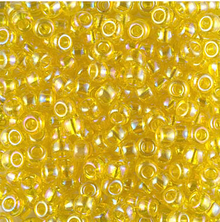
Size Are They? Seed beads sizes are listed as "11/0" or "6/0"
and the like. These very loosely refer to how many
beads per inch it would take, if you lined a particular size up
against a ruler. Thus, "11/0" means that there are 11
beads per inch. "6/0" means that there are six per the
inch. Thus, the smaller the size-number, the
larger the size of the bead.
6/0 seedbeads are apprx. 4mm Carol Wilcox Wells, in her book
THE ART AND ELEGANCE OF BEADWEAVING, gives a well-researched answer
to the question How Many Seed Beads? Using black
opaque seed beads from one particular manufacturer, she came up with
these numbers: BEADS PER GRAM BEADS PER LINEAR
MEASUREMENT BEADS PER SQUARE AREA An amulet purse that is 2"
x 2 1/2" in size, would be 2*2 1/2*2 in area, or 10 square
inches. (2 sides of 2x2.5 inches). 10 square
inches would use, for example, 2850 delica beads (15
grams). NOTE: The sizes and
weights for seed beads with different finishes and/or from different
manufacturers will vary considerably, so you should take these
numbers as a guide, not an absolute. What is it? --
11/0 Delicas or 12/0 Delicas? The Czech seed beads we carry are size 11, except the tri-cuts which are size 12. Bugles are sizes #1, (apprx 3/32 inch), #3 (apprx 1/4 inch), #5 (apprx 1/2 inch), 20mm and 30mm. The Japanese seed beads we carry are size 11, size 6 or size 8. Czech 11/0 seedbeads are available by the hank (usually 35-50grams). Tri-cut seedbeads also are available by the hank (usually 12-19 grams). Japanese 11/0 beads are available by 28-30 gram tubes. Japanese 6/0 beads are available by 24-28 gram tubes. Delicas are sold in 10 gram (sometimes 5 gr for very expensive colors) gram tubes. Seedbeads are made in many countries. Czech beads are perhaps the most widely used. They are consistent in size from bead to bead, and the colors and finishes are less likely to fade in sunlight or water, or wear away when rubbed against other materials and objects. Tri-cut beads are very shiny and glitzy. In a tri-cut bead, both the faceting as well as the color finish or effect, produces the shine.
Japanese seed beads are perfectly consistent in size from bead to bead, and have more durable finishes than Czech beads. They are also more expensive. Some projects, like beaded pouches, are enhanced by the perfect size match of Japanese beads. Other projects are enhanced by minor imperfections in size, that you would get from using Czech seed beads. Other countries make seed beads as well, such as India, France and Italy. You'll find the beads from India in stores like Walmart and Kmart. They are very inexpensive, and very uneven in size of bead and hole size. Seed Beads from France and Italy are very well made, and somewhat on the expensive side. Very few projects work at all when the beads don't approximate the same size. The smaller the bead, the more detailed and professional the finished piece will look. Very experienced beaders often use size 16/0 or smaller in their pieces. Size 11/0 works best for most hobbiests. For children, we often recommend using the Japanese seed beads because they are easier to work with. When people are getting started with seed beads, we suggest trying both the Japanese beads and the Czech beads. The Japanese beads are easier to use because they are more uniform and have a larger and more consistently-sized hole. However, because the Japanese beads tend to be so perfect, you sometimes end up with a piece that looks like a paint-by-number Elvis on velvet. With the Czech beads, you get a more organic, artistic look.
For a listing a books about beading , return to the Book Shop. Beading Supplies may be found in this Seed Beads Alcove. Additional beading supplies are available in the Findings Alcove, along with other jewelry findings, display aids, and packaging.
|
|||||||
|
|
|||||||
|
CENTER FOR BEADWORK & JEWELRY ARTS |
|||||||
|
|
|||||||
|
|
|||||||
|
Many articles
of interest for you... |
|||||||
|
|
|||||||
|