Land of Odds - Jewelry Design Center
RETURN TO: LAND OF ODDS
1. COMPOSITION In this discussion,
we focus primarily on Principles of Composition. These include, The jewelry artist
applies these Principles of Composition by manipulating the elements
of the piece. These elements might include:
"Teaching" Jewelry Design - 3 Approaches There are 3 different approaches for teaching “Jewelry Design”. Each approach makes different assumptions about the process of making jewelry and about the skills/ abilities/ and capabilities the jewelry designer will require. It’s important to understand how you are being taught and led – that is, where the teacher (or how-to author) is coming from – so that you can appreciate what the teacher is saying and trying to accomplish, and how this may or may not apply to your own goals as a jewelry designer.
THE CRAFT APPROACH By far, the most typically-encountered approach is called the Craft Approach. Here you are taught a set of specific steps to follow in order to complete a very defined project. You might be expected to follow a set of step-by-step instructions in a class or read a pattern in a book.You are not taught how to apply those steps to any other project. You are not taught the consequences for choosing one type of bead or clasp or stringing material over another. You are not provided any kind of evaluation about the steps -- for example, are they clear, well-written, relevant, pertinent, user-friendly? You find the Craft Approach taught most often in a bead store or crafts store, or as the basis of how-to books. These stores are in the business of selling classes, books and kits -- basically, selling you "STEPS". If the student has difficulty completing the steps, the Crafts Approach teacher usually suggests going back and re-doing the steps, buying another book of more steps, or taking another class to learn more steps. Some students enjoy
learning from this approach. It's relatively straightforward. It's easy.
There's no pressure to create "Art". The only challenge
is to finish. You don't have to make a great commitment to the craft.
You can concentrate on having fun. The Craft Approach assumes: Some consequences: c. The jewelry artist
is taught to start with a set of instructions or a pattern.
A second approach to teaching jewelry design is called the Art Tradition. If you were studying beadwork or other fine crafts at an art school or most jewelry design programs or community college or university, you would probably be taught from the Art Tradition. The Art Tradition believes that you need to learn a set of rules that you can use to apply to any situation where you are making jewelry. Artistic expression cannot be learned as a set of steps. It is less important that you follow a set of steps. It’s more important to know how to apply art theory to your project at each stage of the process, whatever that process is, and wherever that process takes you. The types of rules you are probably most familiar with are those involving color. What colors go with each other? Which colors are “spring” and which are “fall”? There are also rules involving texture/pattern, shape, balance and harmony, distribution of sizes and colors, interplay of light and shadow, perspective, dimensionality, and the like. These art theories detail what defines successful (and unsuccessful) manipulation of design elements within a piece of art. The Art Tradition, however, very narrowly defines what it considers an acceptable medium for art work. "Jewelry" is understood either as a subset of painting or a subset of sculpture, and subjected to those theories only. "Jewelry" is not seen as its own discipline and medium, with its own special rules, theories, techniques and approaches. Art, Jewelry Design and Fine Craft programs teach from this perspective because they are in the business of selling classes where they teach art THEORIES. The student is encouraged to learn more and more theories, and to experiment with different ways and strategies for applying them. The Art Tradition views jewelry as a subset of either painting or sculpture. There need not be special jewelry design classes, per se, because learning theories from painting or sculpture is sufficient. Achieving "beauty" is paramount. What matters most is how successfully the student has incorporated art theories within the final piece -- as it sits on a pedestal or rests on a mannequin. Thus you see in magazines, galleries and museums, many pieces that are visually stunning, but often not wearable. For example, the bracelet with spikes that would kill the wearer, should she let her arm down; or the ring that would never stay upright on the finger in real life; or the 35 pound necklace that would drag the wearer down by the neck. What is nice about
the Art Tradition, is that the goal is Beauty. The artist is not
encumbered by having to follow specific steps or patterns. Nor is
the artist encumbered by the structural and functional properties
of all the pieces she or he uses -- only their beauty. The artist
does not have to compromise Beauty for Functionality. The Art Tradition assumes:
c. The jewelry designer
is taught to start with a palette of colors and textures.
A third approach
to jewelry design is what we teach at Land of Odds, Be Dazzled Beads
and The Center For Beadwork & Jewelry
Arts – the
Art and Design Tradition. This approach isn’t widespread. This
approach began in schools of architecture. These schools originally
were departments in Schools of Art. Their students
were initially
taught in the Art Tradition. They designed and built buildings and
bridges, without thinking about and dealing with how people, cars,
the weather,
and the surroundings and context interacted and were mutually interdependent
with, with-in and with-out these buildings and bridges. "Departments" of Architecture rebelled, and became "Schools" of Architecture. And hence, a new teaching philosophy – Art and Design – was born. Design was merged with Craft was merged with Art. The focus became
teaching design principles and their applications. Some of
these design
principles are applied in similar ways to all art forms, such
as
painting and sculpture, no matter what the medium. For other principles,
architicture (and in our case, jewelry)
creates it’s own challenges, because all architecture (and by
extension, jewelry) The Art and Design Tradition believes that you teach steps, like in the Craft Approach, and you teach rules, like in the Art Tradition, but that you approach teaching and learning from a developmental perspective. That means, that certain steps and rules should be learned before others, and that continual learning keeps building upon itself. The focus is on the process of construction, so a lot of attention is paid to all the parts, and how they should be chosen, how they should/could and shouldn't/couldn't be used, and how they may or may not be integrated within the whole. The Art and Design Tradition is very relevant for the education and training of jewelry designers, as well. Here, the Jewelry Artist is seen as a multi-functional professional, similar to an engineer who designs and builds bridges. The jewelry designer must bring a lot of very different kinds of skills and abilities to bear, when constructing a piece of jewelry. The professional has to be able to manage artistic design, functionality, and the interaction of the piece with the individual as well as that person's environment. This approach also believes that “Jewelry as Art” should be appreciated as it’s own discipline – not a part of sculpture or painting. And that Jewelry can only be understood as Art as it is worn.
The Art and Design Tradition assumes:
c. The jewelry designer
is taught to start, not only with a palette of colors and
textures, but of parts and components, as well.
the Art Tradition methodical, the Art and Design Tradition is systemic.
JEWERLY DESIGN:
This is how the piece
leads the viewer through sequences of steps. It is a measure of the
degree the piece engages the viewer’s eye. When a piece has multiple and coordinated rhythms, we call this Symphonic Rhythm. For example, in a piece, there might be a clear rhythm set by the use of colors throughout the piece, as well as the positioning of definable forms, such as a series of beaded leaves or other shapes. There may be multiple strands within the same piece, each with its own sense of rhythm.
Black-o-Black-o-Black-o-White-o-Black-o-Black-o-Black-o-White-o
First, the brain/eye try to visually inspect the piece from end to end. The brain/eye want to make a complete circle around the piece. Anything that inhibits, impedes or distracts the brain/eye from making this complete circle, ends up evoking the fear and anxiety response. If this is the case, the viewer begins to label the jewelry boring or ugly, in order to avoid it. This pre-wired "avoidance / fear / anxiety response" protects the individual from things like snakes and spiders. Look at the example of the Ugly Necklace below. I can position it one way, and then another way. I think you can feel in yourself a noticeable difference in how motivated you feel to make a circle around the whole piece. All I've done is alter the pattern, hence rhythm, a little.
The more the viewer is motivated to make the complete circle around the piece, the more the piece will be judged as beautiful, satisfying and appropriate. Rhythm is one of the primary principles used here, though the other principles contribute as well. [The second Cognitive Certainty is discussed in the next section below.] EVALUATE AND SCORE
THE SAMPLES FOR RHYTHM.
2. Pointers Guide viewer to a specific place, or focal point. Examples:
So, the better designed piece has some way to allow the viewer's eye, first to make a complete circle around the piece, and second, to come to rest. The focal point can be an obvious piece, or a subtle configuration of pieces, forms or themes, or a deliberate manipulation of the viewer's perception and interaction with the piece.
A more complex necklace might have more than one pointer within its design.
This is the degree the piece is not disorienting to the viewer, or particularly confusing in terms of what is up and what is down. People always need to orient themselves to their surroundings, so that they know what is up and what is down. They usually do this by recognizing the horizontal planes of the floor and the ceiling of a room (ground and sky outside), and the vertical planes of the walls of a room (buildings, trees and the like outside). Jewelry must assist, or at least not get in the way of, this natural orienting process. It accomplishes this in how its “lines” are arranged and organized. If a piece is very 3-dimensional, then how its “planes” are arranged and organized becomes important, as well. The goal here is to “see” the piece of jewelry, especially when worn, as something that is coherent, organized, and controlled. Design elements we might use to achieve a satisfactory planar relationship
within our piece: Example: Example:
4. Interest “Interest” means the degree to which the artist makes the ordinary…noteworthy. Design elements might include: EVALUATE AND SCORE
THE SAMPLES FOR INTEREST.
How satisfying the numbers and sizes of objects are within the piece. This may form a “pattern”, or not. Too few of any one size, shape or color? Too much? Strange use of size or number?
EVALUATE AND SCORE
THE SAMPLES FOR STATISTICAL DISTRIBUTION.
6. Balance How satisfying the placement of objects (and their attributes) within a piece is. The attributes would include such things as the materials used, the colors, textures and patterns, the sizes, shapes and scales. The statistical distribution of size and number might seem OK, but their placement might be awkward. For example, you might have used purple and yellow beads in the correct proportions (hence, good statistical distribution), but their placement within the piece might not be optimal (hence, bad balance).
EVALUATE AND SCORE
THE SAMPLES FOR BALANCE.
7. Dimensionality The degree to which, whether the piece is flat or 3-dimensional, the placement of objects (and their attributes) is satisfying, and does not compete or conflict with the dimensionality of the piece as a whole. Sometimes dimensionality is achieved through the positioning of masses of objects or planes of interconnected pieces. Othertimes, dimensionality is achieved through color/texture optical effects, such as the use of glossy and matte beads in the same piece.
EVALUATE AND SCORE
THE SAMPLES FOR DIMENSIONALITY.
8. Temporal Extension This principle concerns the degree to which the parts of the piece are integrated into the whole, especially in terms of how the materials relate to their historical use. The idea of “historical use” refers
to one of two situations. For example, you would
not use metalized plastic beads in an Heirloom Bracelet, because
the platings on the beads would wear or chip off long before the
expected "life" of the heirloom bracelet. “Historical Use” may narrowly refer to one specific wearer in particular, or more broadly to a group, social or societal expectations. Other examples:
EVALUATE AND SCORE
THE SAMPLES FOR TEMPORAL EXTENSION.
9. Physical Extension/Finishing When there is (or should be) movement in a piece, there should be clear evidence that the designer anticipated where the parts came from, and where they are going to. Jewelry is worn by people who move, so the design should be a natural extension to such movements, and the stress they put on the piece. Example of bad physical extension/finishing: The dangle earring which has the dangle stuck in a 90 degree angle. Example of bad physical extension/finishing: The crimped bracelet which breaks at the crimp, thus has been incorrectly crimped and has broken from movement and wearing.
The piece should move with the body. It should not put undue stress on any piece, component or section that would result in the jewelry breaking, bending or denting "before its time." The piece should drape well and feel good when worn -- no stratchy edges such as from exposed cable wire, or crushed crimp beads; no forced and too-stiff "circle" where a joint or hinge might be needed Components of the piece should not get "stuck" out of place, or move inappropriately.
10. Parsimony There should be no nonessential elements. The designer should achieve the maximal effect with the least effort or excess.
Good Parsimony shows that the designer has a good sense of the relationship of the parts to the whole.
BRIEF
MENTION OF OTHER SETS OF DESIGN PRINCIPLES
A. PHYSICAL FUNCTION: Jewelry must withstand the forces that usage places on the piece. Design strategies must anticipate whether the piece would be worn daily or occasionally; was expected to last a year, more than a year, a lifetime; was to be worn in situations where there was little movement/activity by the wearer or a lot of movement/activity. The designer does not want the piece to pose any kind of problem of manipulation. The Design and Construction should be conditioned by anatomy and situation. PHYSICAL FUNCTION is understood in terms of MOVEMENT, Flow, Drapery, Flexibility, Rigidity, Volume, Weight, and Torque. It is understood in terms of proportions and sizes and coherency among the parts. It is understood in terms of the relationship of the piece to the purpose it is worn, or what it is worn with. It is understood in terms of how the piece is secured from loss. You don't want to end up with a top-heavy brooch, or a bracelet that is too stiff around the wrist. You don't want a bracelet or necklace to shift position on the body. Wide necklaces must be tapered conically toward the neck to lie flat.
B. PSYCHO-SOCIAL FUNCTION: Jewelry has many uses, including meeting the individual's needs for self-esteem, self-actualization, sex and sexuality, a sense of oneness and uniqueness, a sense of being a part of a larger group or community, a sense of survival and protection, a re-affirmation of values and perspectives, a connection to a higher power or spirituality, fantasy, personal use-goals.
C. FORMS: It is important for the jewelry designer to think in terms of "parts", "forms", and the "piece as a whole". Forms are inter-related objects. For example, they might be sections of beads that seem to be thematically inter-related. Design-control
over forms enables the designer to create a "whole" that is more
than the sum of its "parts".
These
choices involve such things as: For example, it is difficult to mix different materials, such as glass and gemstones, in the same piece. When your brain/eye interacts with most gemstones, it not only focuses on the surface of the bead, but is drawn into the bead at well, so there is a lot of cognitive interaction between person and bead, as she or he tries to make sense of the bead and its qualities. With most glass, the brain/eye focuses on the surface, and that's it. Most glass beads do not draw the eye deeper within them. What results, is that more successful pairing of glass and gemstones would use glass that mimics the effect of gemstones. This might include glass that is frosted or translucent, of might have built up layers of transparent glass, each layer a different color. Another example: 14KT gold beads tend to dent, unless heavy-walled or extra-heavy walled. Most jewelry using 14KT gold beads would be considered "investment-quality". If the beads dent easily, this would be a design-contradiction.
The piece of jewelry should be understood as a series of parts and forms connected by Support Systems. Support systems function like joints, pulleys, rivets, hinges. They allow the piece to take the shape of the wearer's body, and to move comfortably with that person as that person moves. Common
Jewelry Support Systems: 2. Pressure Systems, such as ear clips, pin backs, slip knots, clamps, crimps, snaps. These are pieces that can be tighted or loosened. They allow jewelry to be adjustable in pressure to accomodate individual or situational differences. 3. Clasp Systems. These consist of 2 or more complimentary parts that fit together to make a unit clasp. Clasp systems must have methods of releasing the hold of the clasp to allow for opening and closing. 4. Piercing and Stud Systems. These use long prongs, pin stems or stick pins and clutches. Friction and surface area connections determine success. 5. Sewing Systems. These include the many types of systematic bead stitches which hold the parts together. Different sewing systems can result in different visual and functional outcomes, given the same set of parts. 6. Adapter Systems. These include 2 or more complimentary parts that fit together in order to adapt something so that it may be used within a piece of jewelry. These include things like screw eyes, mounts, bezel and other settings, end caps and bead caps.
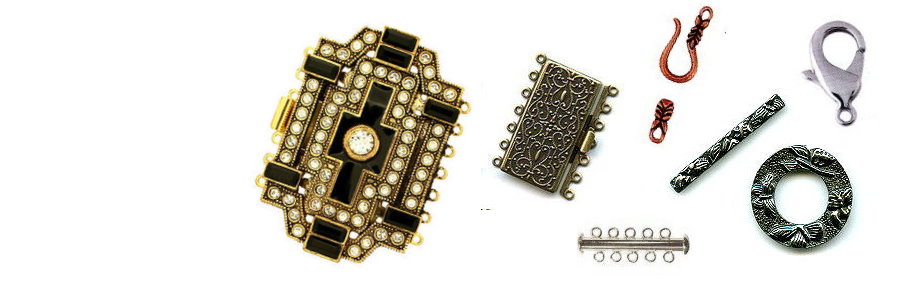
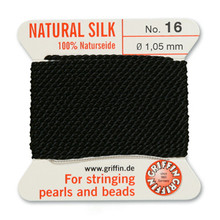
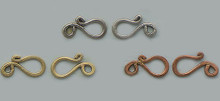
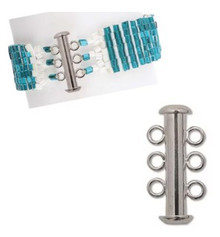
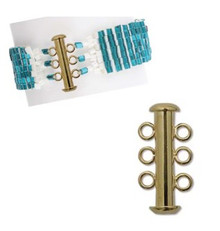
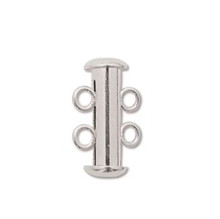
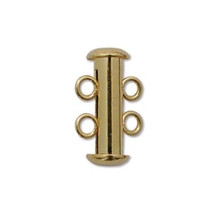
SOME SUMMARY NOTES FROM DISCUSSION ABOUT Stringing beads on a cord is not difficult, but it does require a thorough understanding of the pros and cons of the various parts and stringing materials that you will use. The bead stringer has several goals to achieve: a. An appealing piece The two most important steps in creating a wearable art-piece that will be around and wearable for future generations are: 1. Choice of Clasp The "Clasp Assembly" usually consists of several parts -- it includes all the things that have to come together in order to attach the clasp to the beadwork. Besides the Clasp itself, there are probably jump rings and connectors, crimp beads, clamps or other jewelry findings, and the stringing material. The "Clasp Assembly" is also known as a support system, and it is the most important support system in any piece of jewelry. In any one piece, there are usually 2 or more support systems. The support systems through a necklace or bracelet are similar to the joints in your body or the hinges on a doorframe. They aid movement. They prevent any one piece from being adversely affected by the forces "movement" brings to the piece. They make the piece look and feel better, when worn. The best clasp is one that has no moving parts. These include toggles, buttons, slides, S-clasps, hook and eye clasps and friction clasps. The clasp should be proportional to the beads used in the piece. The full Clasp Assembly should be proportional to the piece as a whole. If half your bracelet is taken up by the Clasp Assembly, then there is a problem here. In better pieces, the clasp seems as if it is an organic and integral part of the rest of the piece. It does not feel as if it were an add-on or after-thought.
However, it adds a lot of time to the creation of a piece. If you are selling your pieces, very often you won't be able to recoup your labor, when using needle and thread. One alternative is to use a flexible cable wire. This goes very quickly and is easy to do. The better cable wires are very strong. There is a stiffness to them that makes the pieces not feel as good or drape as well when worn, in comparison to thread. You also have to use a crimp bead to hold the cable wires in place, and this is a weak design component in the Clasp Assembly. Another alternative is to use a hybrid cable thread, such as FireLine or PowerPro. You use needles with these, but only have to go through the piece one or two times, instead of 3, as you would with nylon thread. The pieces are stiffer than the threads, but drape better than the cable wires. As a designer, then, as long as you know what the ideal stringing materials and clasps are, you can more easily step back from those ideals, and use alternative materials and clasps, and still achieve a great outcome.
|
|
LAND OF ODDS - Jewelry Design Center
Want to reach us right now?
COPYRIGHT 2007 Warren S. Feld